Showing posts with label human rights. Show all posts

Monday, August 27, 2012

Back to School

It's amazing how quickly a well-intentioned goal can become sidelined when late August rolls around.  I had every intention of blogging about the many books I've read over the last month, but unfortunately back-to-school meetings and plans, along with last-minute getaways and family vacations, interfered. So now I will attempt to play catch up!

I have been dying to write about the following book since I read it in early August. The memoir, called It Happened on the Way to War: A Marine's Path to Peace, was the most inspiring book I read all summer. I heard about it from a graduating senior on one of the final days of last school year. I had mentioned that our department was contemplating a "One Book One School" program, which was exactly what her university was doing. This was the book she was to read over the summer before her freshman year at college.

The most intriguing aspect of this book, by Rye Barcott (@ryebarcott), is the dichotomy between the author's passion for the U.S. military and his commitment to peacefully reconciling ethnic violence, particularly in areas of Africa. His desire to maintain peace in the world--shaped in large part by his anthropology professor mother and his Vietnam vet father--drives him to simultaneously enroll in the ROTC program and pursue an independent research project, which involves semi-annual trips to Kiberia, the largest slum in Kenya.

Throughout the approximately ten-year span of the book, Barcott details his experiences in the U.S., Kenya, Somalia, and Iraq. He describes the extreme patriotism he feels for his country, as well as the compassion he feels for the residents of Kiberia. He emphasizes the importance of helping the poor, downtrodden members of society by empowering them to begin their own community outreach programs, clinics, and small businesses so as to increase a sense of responsibility and ownership within the residents of these communities. Barcott also believes in the necessity of a strong military in order to maintain peace and order throughout the world.
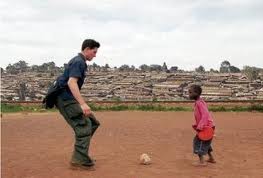
The path to peace is not easy for Barcott, and his relationships and investments do not always go as planned. On several occasions he literally and figuratively falls on his face in his efforts to achieve high military honors and large-scale humanitarian efforts simultaneously. One of his most significant obstacles is fundraising and selecting the best local projects in which to invest. He is at times misunderstood by his fellow Marines and does not always attain top honors in his military trainings as he aspires to do. In Kiberia, an area ruled in large part by gang violence as the Kenyan police find it too dangerous to enter, Barcott--the only white person in Kieberia on most occasions--must learn the appropriate greetings and ways of life as to not be targeted by the gang leaders.

What Barcott achieves by the age of 30 is remarkable and inspiring to anyone who reads it. Incoming college students are a prime audience, since the memoir largely describes the author's accomplishments throughout his late teens and twenties. Nevertheless, this book could certainly be a One Book One School selection for a high school population, too. Students reading at a middle school reading level might have some difficulty with the book's somewhat sophisticated writing style, which I would estimate to be written at about a 10th or 11th grade reading level. Reluctant readers might be turned off by the book's length (352 pages).  However, if these students have any interest in poverty, the military, or human rights, the intriguing subject matter might be all they need to persevere through the challenging spots.  Low readers could also read excerpts or perhaps an easier text with similar themes.

Finally, It Happened on the Way to War: A Marine's Path to Peace would be an excellent text to read in conjunction with a service project or a volunteer assignment. When you close the final pages of the book, you will certainly feel an overwhelming desire to make a difference in the world.

Tuesday, July 24, 2012

Human Rights Issues in YA Literature

Sometime in the mid-1990s, when I was around 10 or 11, my grandmother gave me a book called Zlata's Diarywritten by a young girl (@ZlataFilipovic) living through the war in Bosnia-Herzegovina. Around the same time, two new students arrived in my school; they were Bosnian refugees. After reading Zlata's Diary, did I fully grasp the recent trauma my new classmates had experienced? No, but neither can I say that now, as an adult, I understand their experiences. However, reading Zlata's Diary did open my eyes to the experiences of a girl my age half a world away. It made me curious--not cruel--towards the new kids at my school. It did not traumatize me or give me nightmares, but instead put my life and "problems" into a broader context; suddenly, not being allowed to have my ears pierced seemed unimportant. It sparked in me a curiosity about people in other areas of the world. It caused me to question the evil that exists in the world, but it also inspired me be a source of goodness.
As an adult, I continue to be drawn to literature about people living in places and times that are not my own. Reading Never Fall Down (@McCormickWrites) was both a horrifying and inspiring experience for me. As I read, I continued to have flashbacks to Beah's A Long Way Gone and Wiesel's Night. Like Beah and Wiesel, the protagonist, Arn Chorn-Pond, suffers greatly as he endures the Khmer Rouge's violent reign over his homeland, yet he also rises out of that hopelessness and, as an adult, works tirelessly as a human rights advocate.

Never Fall Down is a fairly simple read for high school students, yet its subject matter is complex and challenging, making it a perfect read for both reluctant readers and high-achieving students. In an English/language arts classroom, discussions of novel text might include the literary themes of war, perseverance, and the will to survive, or the writer's process of turning a true story into a work of fiction. McCormick's choice of voice for her protagonist would be a valuable lesson topic, as well. Finally, this book beckons a discussion of the role of the arts in a people's cultural identity. Why did the Khmer Rouge find it so important to wipe out all traditional Cambodian music and art? What is the value of traditional songs, images, and stories?

Social Studies teachers could also use this text to teach about a variety of historical eras. Never Fall Down not only gives readers insight into the Cambodian Genocide, but also provides a platform for discussing other mass killings such as the Holocaust and those in Bosnia-Herzegovina, Sudan, Rwanda, and the massacres that are occurring in Syria even as I type these words. The innocence of McCormick's child narrator and his at-times naive perspective on the atrocities he witnesses help students to comprehend an otherwise overwhelming topic.

Although it might be tempting to censor books that contain graphic war imagery and violence from middle and high school students, it's also important to remember that living in a bubble disadvantages everyone--victims and bystanders alike. Students should not be prevented from learning about historical or current events just because they paint a picture that not everything in our world is all roses and butterflies. If we want students to become agents of change, we have to show them what needs to be changed. At the same time, we cannot simply hand students books about tragedies and expect them to feel empowered. Opportunities for empowerment--community service projects, food and clothing drives, petitions or letter/email-writing campaigns--should be an integral part of students' experiences, too.

A few of my favorites:
Kiva @kiva
Habitat for Humanity @Habitat_org